

By Mike Zacha, Founder, Zacha Tax Resolution · 27 years in tax resolution
If you’ve received a final IRS Notice of Intent to Levy (Letter 1058, LT11 or CP90), you generally have 30 days from the date on the letter before the IRS can levy your wages, bank accounts, or business income. Use that time to confirm which notice you have, request a Collection Due Process hearing by mailing Form 12153 to the address on your notice, and put a realistic resolution in front of the IRS.
I’ve discussed these letters with thousands of people, and I know the feeling when you see the words “Notice of Intent to Levy.” Here’s what 27 years in the tax resolution industry has taught me: it’s serious, but it’s not the end of the road. The IRS must follow procedure, and even taxpayers who owe money have rights.
In most cases, the law requires the IRS to warn you and give you a chance to respond before it can take your wages, bank funds, or other property. What you do in the next few days matters more than almost anything else in the process, and handled calmly and quickly, this is a problem you can get on top of.
Key Takeaways
- A final notice of intent to levy generally gives you 30 days before the IRS can levy wages or bank accounts.
- Requesting a CDP hearing on Form 12153 within those 30 days generally pauses levy action.
- The form number on your letter (LT11, Letter 1058 or CP90) tells you exactly where you stand. Look up your notice on the IRS website.
- An affordable payment plan, hardship status or a settlement can prevent or release a levy.
- Agreeing to a payment you can’t keep up with often creates a bigger problem than the one you started with.
First, Find Out Which IRS Notice You Actually Have
Not every letter that mentions a levy carries the same weight. Mixing up an early warning with a final deadline is one of the most common and costly mistakes I see.
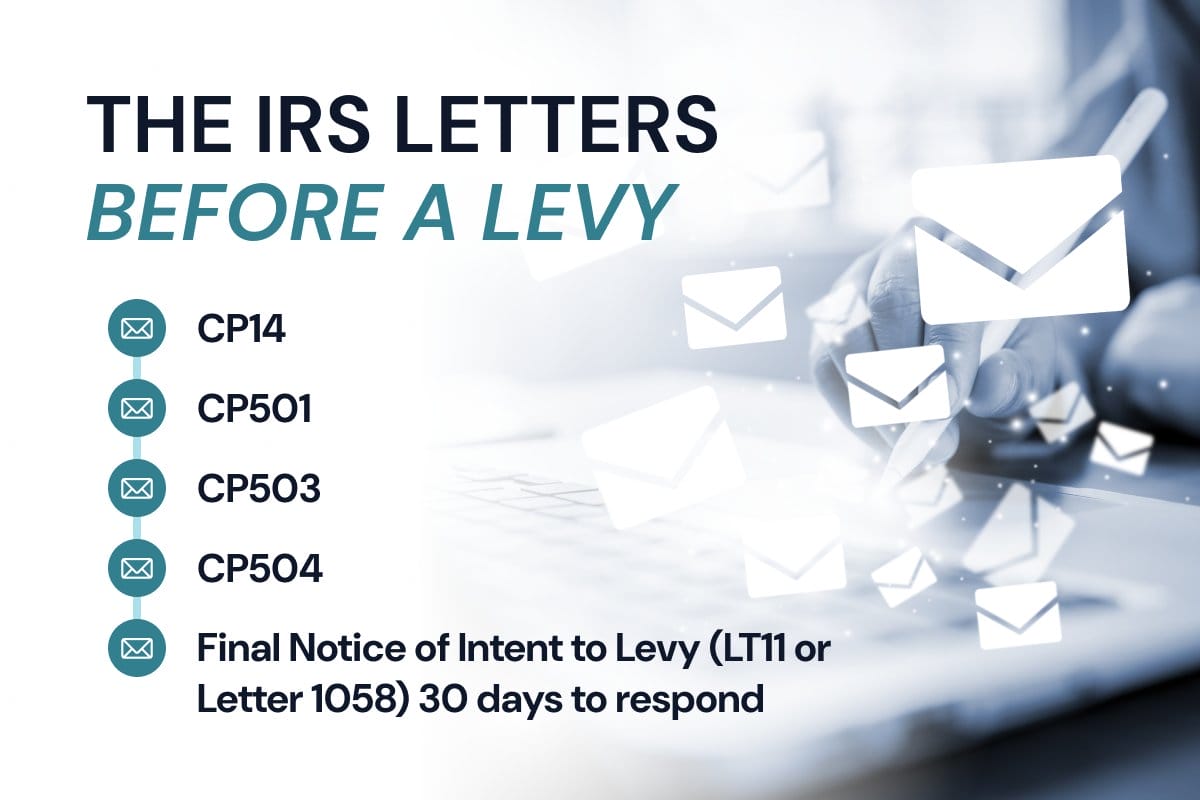
By the time a levy notice shows up, the IRS has usually sent several letters already. It typically starts with a CP14, the first balance-due notice. If that goes unanswered, a CP501 reminder follows, then a CP503 second reminder.
Next comes the CP504, which warns that the IRS may levy your state tax refund or other property. People often mistake the CP504 for the final warning, but it generally doesn’t by itself authorize a levy on your wages or bank account.
The letter that does is the Final Notice of Intent to Levy and Notice of Your Right to a Hearing. Depending on how your case has been handled, it usually arrives as one of three letters:
- Letter 1058 is typically issued when a revenue officer is assigned to your case.
- Notice LT11 is typically issued through the IRS’s automated collection system.
- CP90 is used for certain individual accounts.
If you’re holding one of these, the clock is running. The IRS generally has to wait at least 30 days from the date printed on the notice before it can levy. Don’t judge the letter by its tone or letterhead. Look for the form number, usually printed in a corner of the page. That one detail tells you exactly where you are in the process.
Your 30-Day Window to Request a CDP Hearing
Most people see those 30 days as a countdown. I’d encourage you to see them as leverage, because this is the point where you have the most say in how your case plays out.
Within 30 days of the date on the notice (not the day you opened it), you have the right to request a Collection Due Process (CDP) hearing. You do this by filing Form 12153, Request for a Collection Due Process or Equivalent Hearing, and mailing it to the address listed on your notice.
A timely request generally pauses levy action while the IRS Office of Appeals reviews your case. That pause gives you room to organize your finances and weigh your options. It also means you can have a real conversation with Appeals instead of making a decision under pressure.
At the hearing, you can propose an alternative such as an installment agreement. You may also be able to dispute the debt itself if you never had a prior chance to, for example if you never received an earlier notice.
Talk to Us Before Your 30 Days Run Out
What if You’ve Already Missed the 30 Days?
You still have an option. Within one year of the notice date, you can request an Equivalent Hearing using the same Form 12153. It gives you a similar chance to be heard by Appeals. However, it generally doesn’t pause collection activity, and you can’t take Appeals’ decision to the U.S. Tax Court.
If you don’t respond at all, the CDP protection is gone. The IRS can then move forward with a levy without sending another warning.
What an IRS Levy Can and Can’t Do
Each type of levy works differently. Understanding them helps you see which risk matters most for you.
- A bank levy freezes the balance in your account on the day the bank receives the levy. It doesn’t touch future deposits. By law, the bank must hold the frozen funds for 21 days before sending them to the IRS, which gives you a short window to negotiate a release. A bank levy is generally a one-time hit, not ongoing. If your deadline hasn’t passed yet, here’s how to prevent a bank levy before it happens.
- A wage levy, often called a garnishment, is different because it continues. It takes a portion of every paycheck until it’s formally released. Part of each paycheck is exempt to cover basic living expenses, based on the tables in IRS Publication 1494. That exempt amount can be smaller than people expect. If a levy has already started, learn what rights you still have after you’ve been levied.
The IRS can also levy other assets, depending on what it knows about your finances. These include Social Security benefits (generally up to 15% through the Federal Payment Levy Program), retirement accounts, business accounts receivable and other property.
And the question almost everyone asks me: will they take my house? Seizing a primary residence is rare, and it requires extra legal steps, including court approval.
Read whether the IRS can take your house for back taxes and what usually happens instead.
Your Options for Stopping or Getting an IRS Levy Release
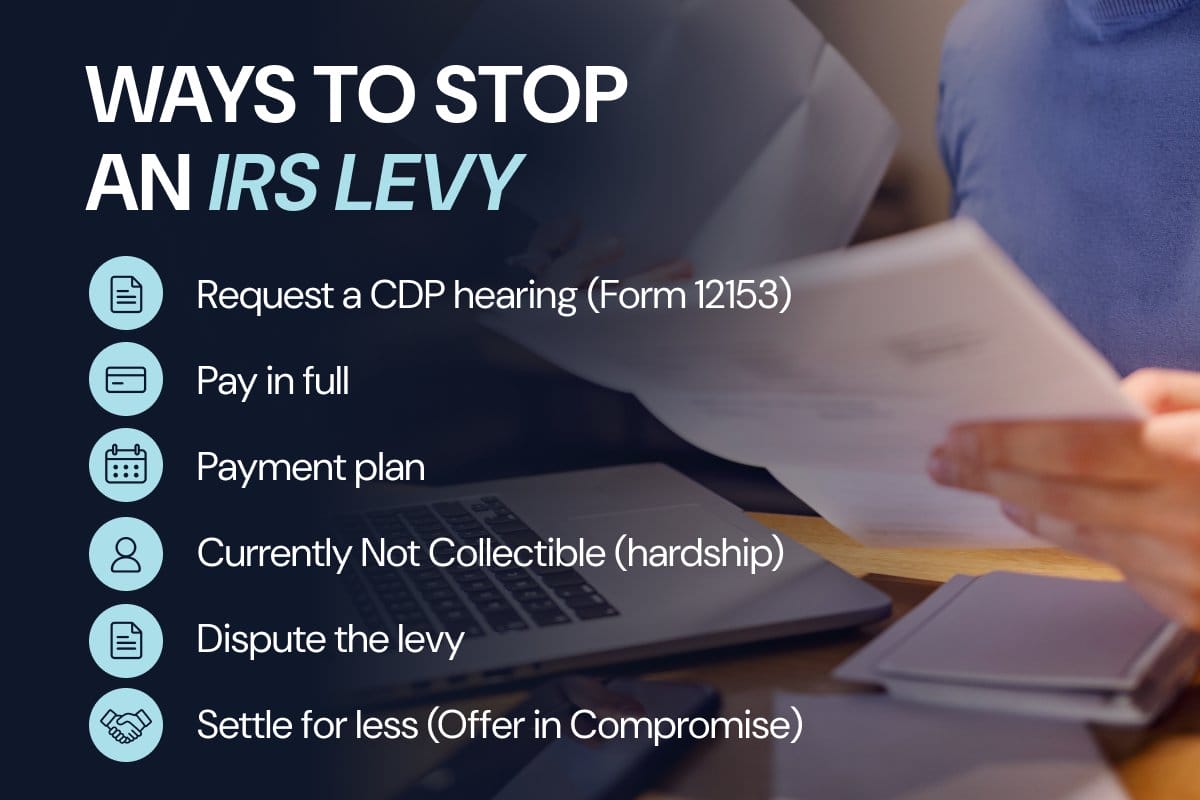
Federal law gives you several legitimate ways to prevent a levy or get one released. The right one depends on how much you owe, what you can realistically pay and how the debt came to be. What works beautifully for one person can be exactly wrong for another.
- Pay in full. If paying the balance is within reach, it ends the matter. It’s always worth considering first.
- An installment agreement. The IRS generally prefers a workable payment plan to active enforcement. A plan proposed in good faith often prevents a levy or gets one released.
- Currently Not Collectible status. If paying anything right now would create real hardship, this status pauses active collection. It doesn’t erase the debt, and interest keeps accruing.
- Disputing the levy. This applies if the levy was issued in error, after the collection statute of limitations expired, or against property worth far more than you owe.
- An Offer in Compromise. If your finances genuinely support it, you may be able to settle for less than the full amount. Eligibility depends heavily on your income, expenses and assets, and not everyone qualifies.
One warning from experience: the most expensive mistake I see is agreeing to a payment you can’t afford, just to make the letter go away.
When that plan defaults, your peace of mind goes out the window and the IRS is ready to collect again. A plan that fits your real budget, even one that takes longer, protects you far better.
Who Should Help You Stop an IRS Levy?
Here’s how I explain it to people. If someone fell in your place of business, broke their leg and sued you, would you ask their lawyer for advice on how to defend yourself?
Of course not. You’d want someone in your corner. Your tax debt works the same way. The collector at the IRS isn’t a bad person, but their job is to collect as much as they can, as fast as they can.
Relying on them to explain your options puts you in a difficult spot, especially because most people don’t know what they shouldn’t say. There is a procedure, and even taxpayers who owe money have rights. You deserve someone whose only job is protecting yours.
What to Do This Week After a Final Notice of Intent to Levy
You don’t need to solve everything today. You just need to take the next few steps, in order.
- Find the form number and the date on your notice. Count 30 days from that date and put it in your calendar today.
- Gather your financial basics. This means recent pay stubs, bank statements and a rough list of monthly expenses. You’ll need them whichever option you choose.
- Decide on your path before the deadline. That might be requesting a CDP hearing, proposing a payment arrangement or exploring other relief.
- Don’t sign up for terms you can’t keep. A payment that feels manageable on paper but strains you every month tends to fail.
- Get a second set of eyes on it. Clients regularly tell me they learned more about their situation in a ten-minute conversation than they had in a year of handling it alone.
How Zacha Tax Resolution Helps
Every case starts with a free conversation with me. I’ll go through your situation personally and explain it in plain terms, so by the end of that call, you’ll understand exactly where you stand. You’ll then get your resolution strategy and our fee in writing, along with clear guidance on your options, before you commit to anything.
From there, a licensed Enrolled Agent reviews your case a second time to confirm the strategy is the right fit, then handles your representation. Barring unusual situations, the taxing authorities talk to us, not you.
Request a Free Consultation
The Bottom Line
A final IRS Notice of Intent to Levy is serious, but it’s designed to give you a real chance to respond before anything happens to your paycheck, your bank account or your business. In most cases, you have 30 days. Use them to confirm which notice you have, request a hearing on Form 12153 if you need one, and put a realistic plan in front of the IRS.
In 27 years, I’ve seen that the people who come through this best aren’t the ones who owed the least. They’re the ones who acted within the window. If you’re not sure where to start, that’s exactly what a first conversation is for.
Frequently Asked Questions About a Notice of Intent to Levy
Here are the questions I hear most often from people holding a levy notice.
Can I request a CDP hearing online?
Generally, no. Form 12153 usually has to be mailed, or faxed if your notice gives a fax number, to the address on your specific notice. Using a general IRS address can delay processing, so always use the details printed on your letter.
Does requesting a hearing stop interest and penalties?
No. A timely CDP request generally pauses levy action, but interest and certain penalties continue to accrue on the unpaid balance while Appeals reviews your case. That’s one reason a realistic resolution plan matters, not just a delay.
What if I can’t gather all my documents before the deadline?
File Form 12153 on time anyway. You can generally send supporting financial documents to Appeals after the request is filed. The deadline is what protects your rights; your paperwork can catch up.
Is a Notice of Intent to Levy the same as a tax lien?
No. A lien is a legal claim against your property that’s recorded publicly. A levy is the actual taking of money or property. The IRS sends a separate notice when it files a lien, and the two come with different appeal rights and deadlines.
How long does the IRS have to collect a tax debt?
Generally 10 years from the date the tax was assessed. Some actions, including certain appeals and settlement offers, can pause that clock. Knowing your exact collection deadline can change which option makes the most sense for you.
Get Your Free Consultation
This article is for general informational purposes only and is not a substitute for advice about your specific situation. Nothing in this article guarantees any particular outcome, result or amount of tax relief. Eligibility for any collection alternative depends on the specific facts of your case and the tax law in effect at the time. Zacha Tax Resolution’s representation services are provided by a Licensed Professional authorized to represent taxpayers before the IRS under Treasury Department Circular 230. If you’ve received a Final Notice of Intent to Levy and aren’t sure what to do next, Zacha Tax Resolution can help you understand your options and respond before the deadline passes.