

By Mike Zacha, Founder, Zacha Tax Resolution · 27 years in tax resolution
If you’ve had an IRS payment plan denied (the IRS calls it a rejected installment agreement), you still have options. You can generally appeal within 30 days through the Collection Appeals Program using Form 9423, submit a stronger revised proposal, or move to a different resolution such as Currently Not Collectible status or an Offer in Compromise. The IRS will tell you why they said no, and that reason decides which path makes sense.
In 27 years of doing this work, I’ve talked with a lot of people who’ve just had an installment agreement rejected. Many tried to set up a plan on their own or with their local CPA, did everything they thought was right and still got turned down. It feels like a dead end, but it isn’t. A rejection is a setback with a clear process behind it.
Here’s why payment plans get rejected, how to appeal and what to do if an appeal isn’t the right move.
Key Takeaways
- A rejected IRS payment plan isn’t final. You can usually appeal, revise your proposal or choose another option.
- A Collection Appeals Program appeal on Form 9423 generally needs to be filed within 30 days of the rejection notice.
- Unfiled returns, a payment the IRS considers too low, and incomplete financial forms seem to be the most common reasons for rejection.
- The IRS generally can’t levy while your request is pending, for 30 days after a rejection and while a timely appeal is under review.
- An affordable plan you can keep is worth more than an aggressive one that defaults.
Why Was My IRS Payment Plan Denied?
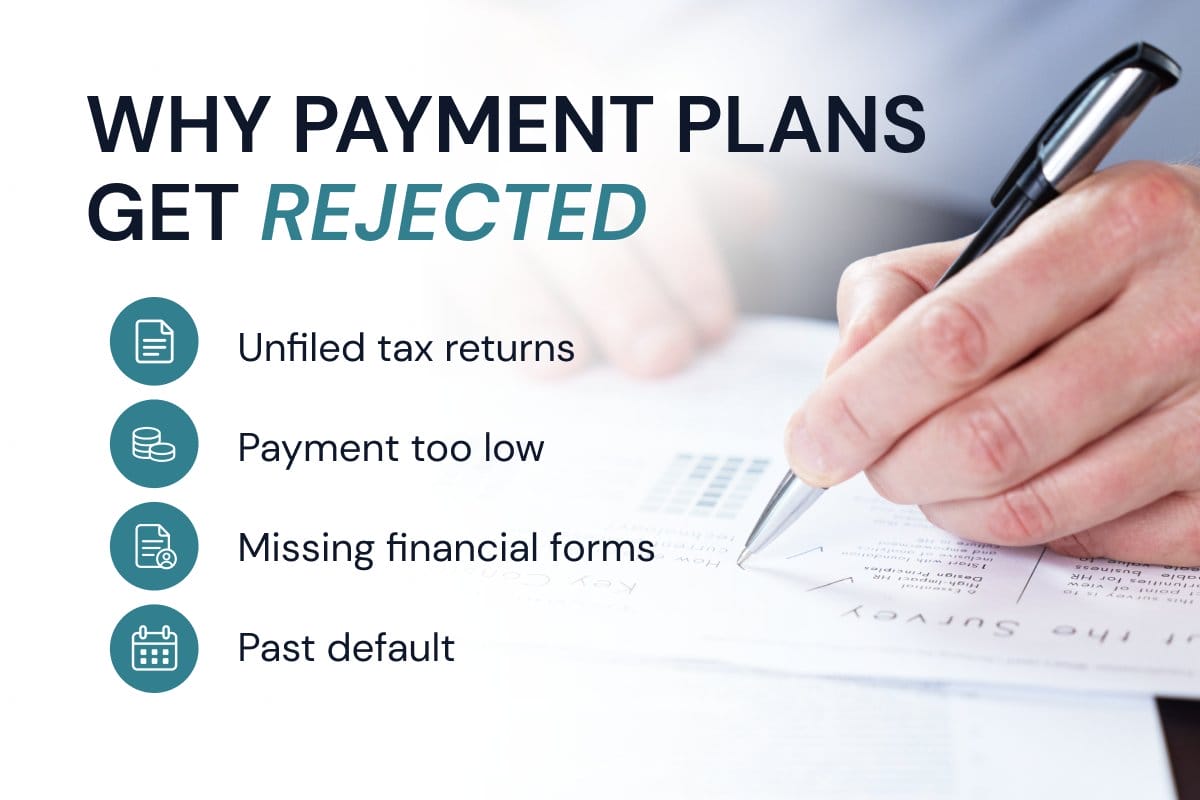
The IRS turns payment plans down for a handful of common reasons. Your rejection letter should state which one applies to you, and that’s where the fix starts.
Unfiled Tax Returns or Missing Estimated Payments
Compliance problems are one of the most frequent causes. If any tax return is unfiled, or you’re behind on this year’s estimated tax payments, the IRS typically won’t approve a plan until those gaps are closed. It doesn’t matter how reasonable your proposed payment is.
Business owners face one more check. To qualify for an IRS payment plan for businesses, you generally need to be current on your payroll tax deposits. A business that keeps falling behind on new deposits while asking for time on old ones will usually be turned down.
A Payment the IRS Considers Too Low
Once a balance goes above roughly $50,000 (the IRS adjusts its thresholds from time to time), the IRS generally compares your income and expenses against its Collection Financial Standards.
These are set dollar amounts for housing, transportation and basic living expenses, adjusted for your area and household size. If your proposed payment is lower than what those standards say you can afford, the request can be denied, even if the number feels right to you.
Missing or Incomplete Financial Forms (433-F, 433-A, 433-B)
Larger balances usually require a financial disclosure form: Form 433-F for many individuals, or the more detailed Form 433-A for self-employed taxpayers and more complex cases. Gaps, inconsistencies or figures you can’t support are a common reason for rejection.
This is also where people hurt their own case without realizing it. Most taxpayers don’t know which expenses the IRS allows or how it will read the numbers on the form. Allowable costs get left off, and the payment the IRS calculates ends up higher than the household can actually bear.
You Defaulted on a Previous IRS Payment Plan
If you’ve defaulted on an installment agreement before, the IRS may be less willing to approve a new one without extra conditions, such as direct debit payments or a higher monthly amount.
How to Appeal a Rejected IRS Payment Plan?
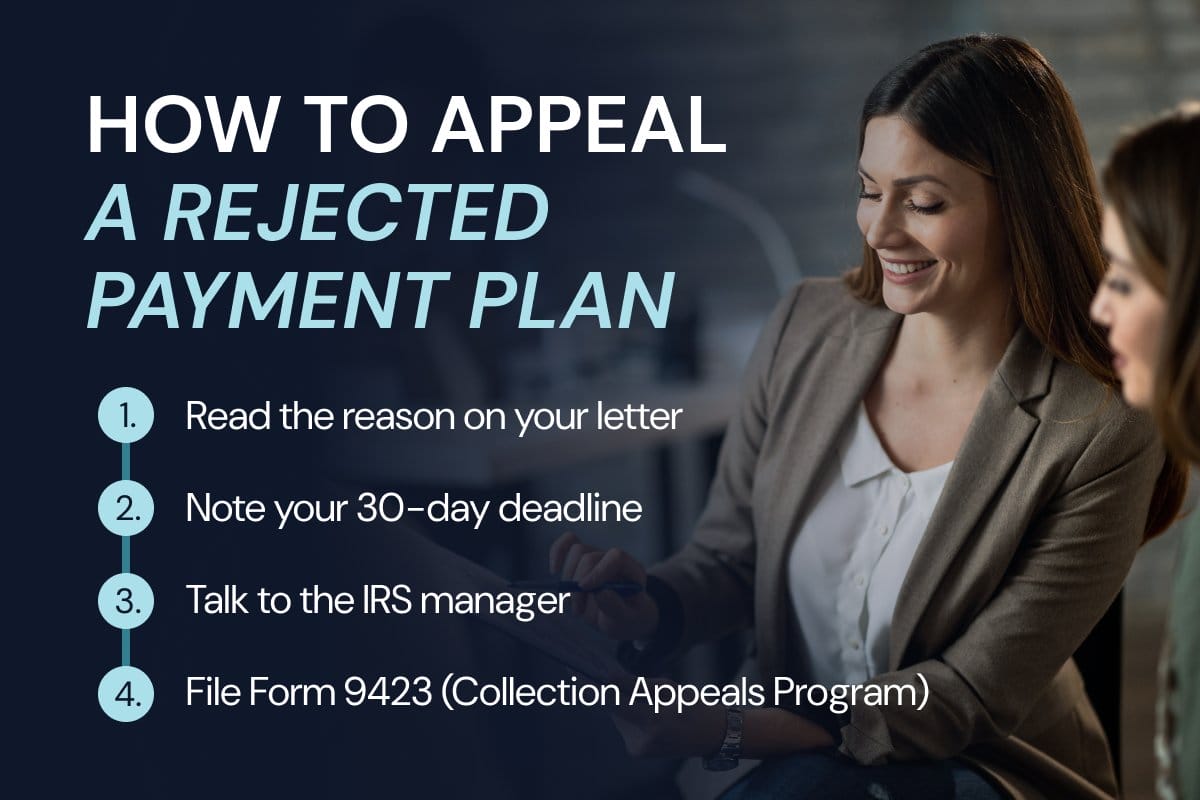
When your request is rejected, the IRS is required to tell you about your appeal rights. Your main option is the Collection Appeals Program (CAP), using Form 9423, Collection Appeal Request.
You generally need to file within 30 days of the rejection or termination notice. If you miss that window, your CAP rights for that decision may be gone. Before filing, it’s often worth asking to speak with the manager of the IRS employee who handled your request, such as the revenue officer’s manager. Some rejections get resolved at that level without a formal appeal.
CAP also moves faster than most IRS processes, which matters when collection action is close. And it isn’t only for new requests. You can use it if an installment agreement you already had in place is terminated.
However, there’s one trade-off. Unlike a Collection Due Process hearing, a CAP decision is generally final, and you can’t take it to the U.S. Tax Court. That makes it quick, but it also means you want to make your strongest case the first time.
Filing on time also keeps your account protected while you sort this out. The IRS generally can’t levy for that debt while your request is pending, for 30 days after a rejection and while a timely appeal is under review.
If you’ve also received a final levy notice, read what to do after a Notice of Intent to Levy, because that letter comes with its own 30-day hearing rights.
Get Help With Your Appeal Before the 30-Day Deadline
What if the Appeal Doesn’t Work? Other IRS Payment Plan Options
An appeal isn’t the only path, and it isn’t always the right one. Depending on why your installment agreement was rejected, one of these may fit better.
- A revised proposal. This is often the simplest fix. Raising the payment, extending the term or sending complete, well-supported financials can get a new request approved without any appeal.
- A partial payment installment agreement. A PPIA allows a lower monthly payment when your finances can’t support full repayment before the collection statute of limitations expires. The IRS reviews it periodically and may reassess your situation over time.
- Currently Not Collectible status. If your income barely covers necessary living expenses, CNC status pauses active collection. It doesn’t erase the debt, and interest and certain penalties keep accruing.
- An Offer in Compromise. If your income, expenses and asset equity genuinely support it, you may be able to settle for less than you owe. Only a portion of offers are accepted each year, so it isn’t the right fit for everyone.
- Fixing compliance first. If the rejection was about unfiled returns or missing estimated payments, closing those gaps is often the fastest route to approval. No amount of documentation overcomes an open compliance problem.
Why an Affordable IRS Payment Plan Beats a Fast One
Here’s what I see over and over. People feel backed into a corner, so they agree to whatever gets the IRS off the phone. Some take out a home equity loan. Others sign up for a monthly payment they already know they can’t keep.
Those plans tend to default, and a default leaves you in a worse spot than a rejection. The IRS becomes less willing to approve the next request, and collection can start up again. If that’s already happened, learn what rights you still have after you’ve been levied.
A rejection, on the other hand, is a chance to build a plan that actually fits your budget. If your rejection came after a final levy notice, it’s also worth knowing how to prevent a bank levy before it happens.
What to Do Next After the IRS Rejects Your Installment Payment Plan
Take these steps in order. Each one makes the next decision easier.
- Read the rejection notice closely. It should state why your request was denied, and that reason should drive your next move.
- Check your CAP deadline. Look at the date printed on the notice and count 30 days from there. That’s how long you have to file the appeal, and it’s easy to lose track of, so write it down somewhere you’ll see it.
- Gather your financial documents. Pull together your income, expenses and assets. You’ll need them whether you appeal, resubmit or choose another option.
- Close any compliance gaps. File missing returns and catch up on estimated payments or payroll deposits, because these block almost every resolution option.
- Pick the path that fits. Appeal if you believe the IRS made a mistake or misapplied its standards. Revise your proposal, or look at a PPIA, CNC status or an Offer in Compromise, if your finances have changed since you applied.
How Zacha Tax Resolution Helps
When you call, you talk to me first. I’ll look at why your plan was rejected and what your numbers can realistically support, and I’ll give you straightforward guidance on the best way forward. You’ll get your strategy and our fee in writing before you commit to anything.
A Licensed Professional then reviews your case a second time to confirm the strategy is the right fit and handles your representation, including any appeal. From there, the IRS deals with us instead of you.
Request a Free Consultation
The Bottom Line
I know having your installment agreement rejected is frustrating, especially when you were trying to do the right thing. But in my experience, it’s rarely the end of the road. Start with the reason the IRS gave you, because that tells you what to fix. Then use your 30 days to come back with a plan you can actually afford.
IRS Payment Plan Denied: Frequently Asked Questions
These are the questions people ask me most after an installment agreement is rejected.
How long does an IRS CAP appeal take?
CAP appeals are designed to move faster than other IRS appeals. Decisions often come within weeks rather than months, and sometimes sooner, though timing depends on IRS workload and how complex your case is.
Can I reapply for an IRS payment plan after a rejection?
Yes. A rejection doesn’t stop you from submitting a revised proposal. Fixing whatever caused the first denial, whether that’s the payment amount, missing documents, or a compliance gap, often makes the second request much stronger.
Do IRS interest and penalties stop during an appeal?
No. Interest and applicable penalties generally keep accruing on the unpaid balance throughout the appeal, whatever the outcome.
Can the IRS levy while my appeal is pending?
Generally, no. The IRS can’t levy while an installment agreement request is pending, for 30 days after a rejection and while a timely appeal of that rejection is under review. There are narrow exceptions, such as when the IRS believes collection of the tax is in jeopardy.
What’s the difference between CAP and a CDP hearing?
A CDP hearing is tied to a final levy notice or a lien notice, has its own 30-day deadline and its decision can be taken to Tax Court. CAP covers a wider range of collection actions, including rejected payment plans, and moves faster, but its decision is generally final.
Get Your Free Consultation
This article is for general informational purposes only and is not a substitute for advice about your specific situation. Nothing in this article guarantees any particular outcome, including approval of any installment agreement, appeal or alternative resolution. Eligibility depends on the specific facts of your case and the standards in effect at the time. Zacha Tax Resolution’s representation services are provided by a Licensed Professional authorized to represent taxpayers before the IRS under Treasury Department Circular 230. If your installment agreement was rejected and you’re not sure what to do next, Zacha Tax Resolution can help you figure out the right path forward.