

By Mike Zacha, Founder, Zacha Tax Resolution · 27 years in tax resolution
An IRS bank levy can often be prevented if you act before the deadline on your Final Notice of Intent to Levy. The IRS generally needs to wait at least 30 days from the date on that notice, and a timely hearing request, payment plan or hardship status can stop the levy before it goes through. In fiscal year 2025, the IRS issued more than 339,000 levies to third parties such as banks and employers, according to the IRS Data Book.
One of the questions people ask me most is how to reverse a bank levy. The better question is how to stop one before it starts. If you’re holding a Final Notice of Intent to Levy, you still have time to prevent it from happening. In 27 years, I’ve personally reviewed roughly 10,000 tax debts, and this window is where you have the most say in what happens next.
Key Takeaways
- A Final Notice of Intent to Levy is a warning, not a frozen account.
- The IRS generally can’t levy your bank account until at least 30 days after the date on the notice.
- A timely CDP hearing request, payment plan request or Offer in Compromise generally pauses levy action.
- If a levy has already hit, your bank must hold the funds for 21 days before sending them to the IRS.
- Stopping one levy doesn’t resolve the debt, so you still need a plan you can keep.
Why You Still Have Time Before an IRS Bank Levy
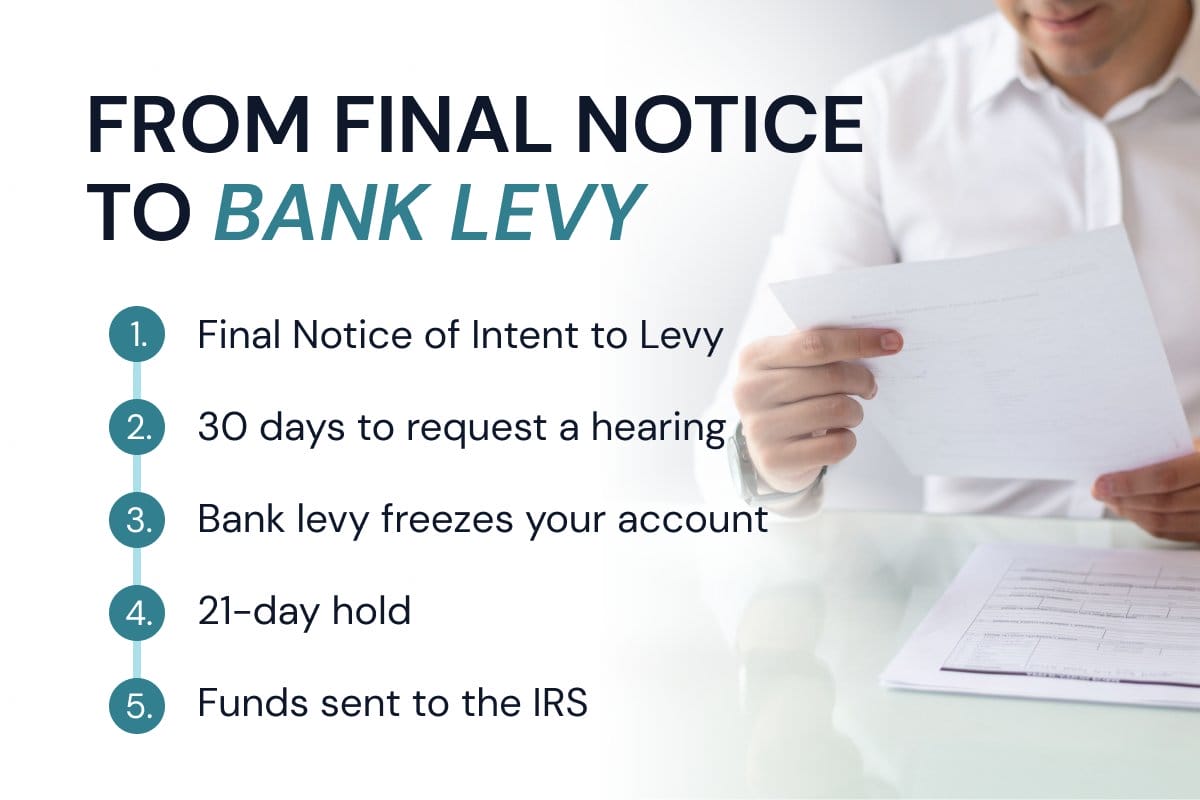
A Final Notice of Intent to Levy usually arrives as Letter 1058, Notice LT11 or, for certain individual accounts, CP90. Whichever one you have, it’s a warning that a levy is coming, not proof that your account has already been frozen.
By law, the IRS generally waits at least 30 days from the date on that notice before it can levy your bank account. That window exists so you have a real chance to resolve the debt or challenge the levy before any money moves.
The most important thing you can do is respond before the window closes. Doing nothing is the one choice that lets the levy go forward on schedule. If you’re not sure which notice you have, read what to do after a Notice of Intent to Levy.
How to Stop an IRS Levy Before It Hits Your Bank Account
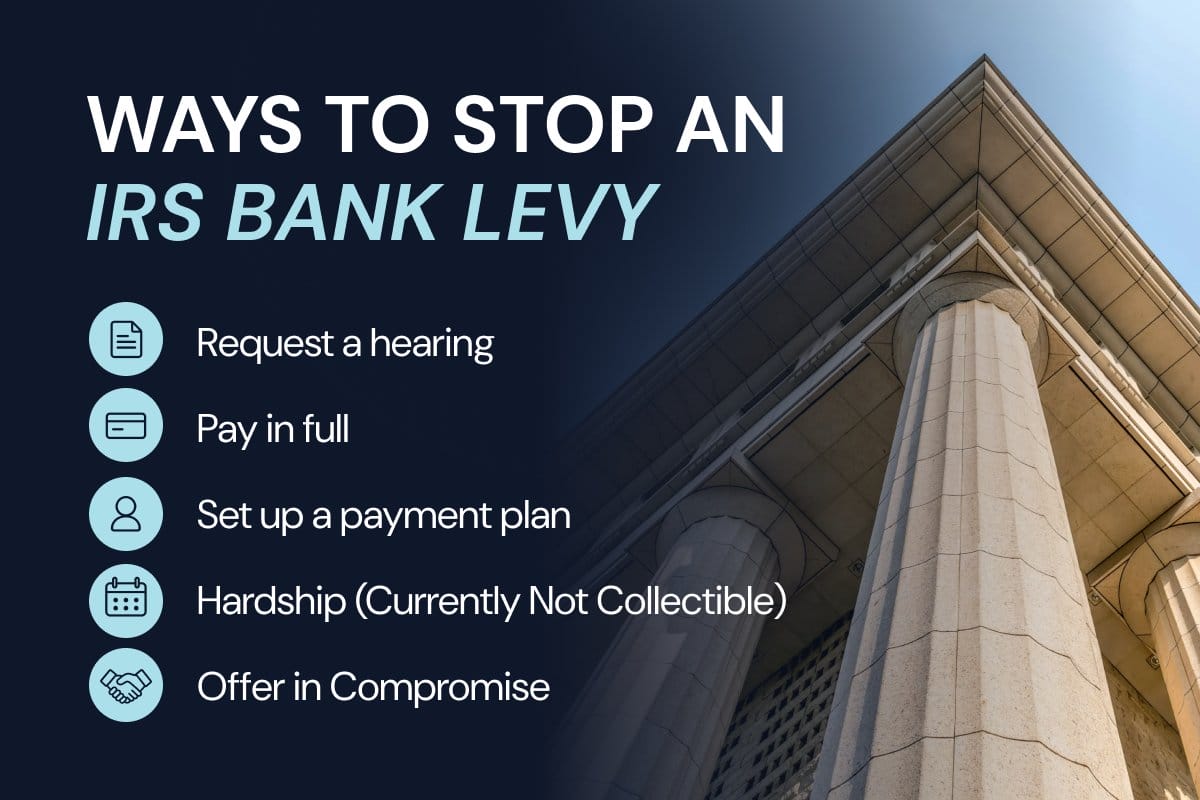
Several legitimate options can stop an IRS bank levy before it starts. The right one depends on your balance, your income, and how the debt accrued.
Pay the Balance in Full
If paying in full is within reach, it ends the matter and removes the basis for the levy. It’s always worth considering first.
Request a Collection Due Process Hearing
Within 30 days of the date on your notice, you can file Form 12153, Request for a Collection Due Process or Equivalent Hearing. A timely request generally pauses levy action while the IRS Independent Office of Appeals reviews your case. That pause gives you time to put one of the other options in place without a levy hanging over you.
Set Up an Installment Agreement
The IRS generally prefers a workable payment plan to enforced collection, and it generally can’t levy while your installment agreement request is pending. Payment plans are common: the IRS set up more than 3.1 million new installment agreements in fiscal year 2025, according to the same IRS data. If your plan has already been turned down, here’s what to do when an installment agreement is rejected.
Ask for Currently Not Collectible Status
If your income barely covers necessary living expenses, Currently Not Collectible status pauses active collection, including levies. It doesn’t erase the debt, and interest and penalties keep growing while it’s in place.
Consider an Offer in Compromise
If your finances genuinely support it, you may be able to settle the debt for less than the full balance. The IRS generally can’t levy while an offer is being considered, but eligibility depends heavily on your income, expenses and assets, and not everyone qualifies.
Talk to Us About Your Options
What Happens When an IRS Bank Levy Hits Your Account
An IRS bank levy freezes the balance in your account on the day the bank receives it. It doesn’t reach deposits made after that day, but the IRS can issue another levy later if the debt is still unpaid.
Under Internal Revenue Code Section 6332, your bank generally holds the frozen funds for 21 days before sending them to the IRS. That hold gives you a real window to get the money released.
Joint accounts can be frozen too, even when the other account holder doesn’t owe the tax. If that’s your situation, the other owner may be able to challenge the levy.
Already Past the Deadline? How to Reverse a Bank Levy
If the 30 days have run out and the levy has hit, it isn’t necessarily too late. Use the 21-day hold to request an IRS bank levy release by calling the IRS phone number on your levy notice as soon as you learn about it.
The IRS generally releases a levy in certain situations, including when you’ve entered into an installment agreement or when the levy creates an economic hardship. Once a release is approved, the IRS sends a formal release to your bank. Here’s how an IRS levy release works in more detail.
Speed matters here. Stopping the transfer during the 21-day hold is far easier than getting money back after the bank has sent it to the IRS.
Keeping an IRS Bank Levy from Coming Back
Preventing or releasing a bank levy deals with the immediate problem, but it doesn’t resolve the tax debt on its own. Whatever stopped the levy, whether that’s a payment plan, hardship status or a hearing outcome, becomes your plan for the debt going forward.
Stay current with that plan and file future returns on time. A missed payment can put you back where you started. And if you’re worried about your home as well, read whether the IRS can take your house for back taxes.
What to Do Before Your Deadline Passes
Take these steps in order. Each one makes the next decision easier.
- Check the date on your notice. Count 30 days from that date and put the deadline in your calendar today.
- Gather your financial information. Pull together your income, expenses, bank statements and pay records, since you’ll need them whichever option you choose.
- Pick your path before the deadline. That might be requesting a CDP hearing, proposing a payment plan or asking for hardship status.
- If your account is already frozen, don’t wait it out. The bank holds the funds for 21 days, which gives you time to ask for a release before the money goes to the IRS.
- Get a second set of eyes on it. The right option depends on your numbers, and a short conversation can help you see it clearly.
How Zacha Tax Resolution Helps
When you call, you talk to me first. I’ll consider your notice, your deadline and what your numbers can realistically support, and I’ll give you straightforward guidance on which option fits. You’ll get your strategy and our fee in writing before you commit to anything.
A Licensed Professional then reviews your case a second time to confirm the strategy is the right fit and handles your representation. From there, the IRS deals with us instead of you.
Request a Free Consultation
The Bottom Line
A Final Notice of Intent to Levy is serious, but it’s also your best opportunity to prevent an IRS bank levy before it happens. In most cases, you have 30 days. Use them to request a hearing, propose a plan you can afford or ask for hardship status. You have rights, there’s a procedure, and with the right guidance, this is a problem you can get on top of.
IRS Bank Levy: Frequently Asked Questions
Here are the questions I hear most often from people facing an IRS bank levy.
Can I get more time before the 30-day deadline?
Generally, no. The 30-day window to request a Collection Due Process hearing is set by law. You can still request an Equivalent Hearing within one year, but it generally doesn’t pause collection, so acting inside the 30 days matters.
Will a payment plan release money that’s already frozen?
Not automatically. An installment agreement is generally grounds for releasing a levy, but you still have to request the release. Doing it during the 21-day hold gives you the best chance of stopping the transfer before the funds are sent.
Can the IRS levy my bank account more than once?
Yes. An IRS bank levy only takes what’s in the account on the day it arrives, so the IRS can issue another one if the debt is still unresolved. For the same tax period, you generally won’t get a new 30-day hearing notice first.
Can the IRS levy a joint bank account?
Generally, yes. The IRS can freeze a joint account even if only one owner owes the tax. The other owner may be able to challenge the levy and show which funds belong to them.
Does the 21-day hold apply to business bank accounts?
Yes. The 21-day hold applies to bank deposits generally, including business accounts. For a business, a frozen account can affect payroll and suppliers quickly, so acting before the deadline is especially important.
Get Your Free Consultation
This article is for general informational purposes only and is not a substitute for advice about your specific situation. Nothing in this article guarantees any particular outcome, including prevention or release of a bank levy. Results depend on the specific facts of your case and the law in effect at the time. Zacha Tax Resolution’s representation services are provided by a Licensed Professional authorized to represent taxpayers before the IRS under Treasury Department Circular 230. If you’ve received a Final Notice of Intent to Levy and want help figuring out your options before the deadline, Zacha Tax Resolution can help.